Bypass
Valve Installation and Adjustment
[ I have added this section after receiving a
few inquiries for installation help. ]
Installation
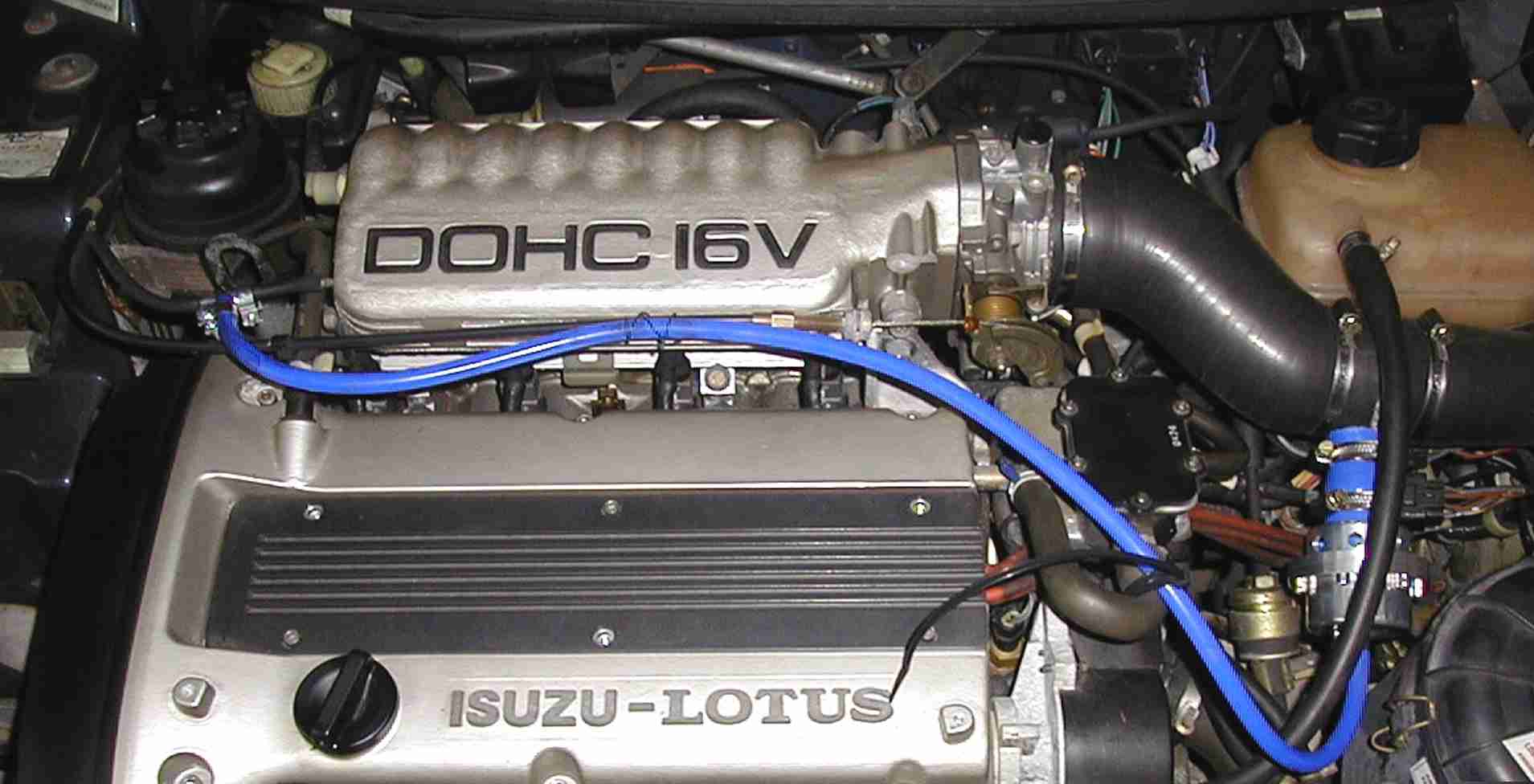
 Installing the bypass plumbing itself is
fairly simple and straight-forward. Be sure the ends fit tight
since it will be under pressure from the turbo! Mount the
plumbing tube so the bypass valve faces straight forward and the
"adjustment screw" is in front--(see pictures). Tighten the hose clamps on both ends of
the plumbing. Later you will learn how to adjust this screw so
the bypass valve opens when you want.
Installing the bypass plumbing itself is
fairly simple and straight-forward. Be sure the ends fit tight
since it will be under pressure from the turbo! Mount the
plumbing tube so the bypass valve faces straight forward and the
"adjustment screw" is in front--(see pictures). Tighten the hose clamps on both ends of
the plumbing. Later you will learn how to adjust this screw so
the bypass valve opens when you want.
With the plumbing in place, connect one end
of the long, little vacuum hose to the front nipple on the bypass
valve (there is a second nipple that should be left alone--on the HKS valve). The
little vacuum hose is then run straight across in front of the
manifold to the right from the bypass valve where you will splice
it into the "boost gauge sensor tubing." The boost
gauge sensor is a reddish circular unit that is mounted to the
right side of the engine bay. There is a small vacuum hose that
comes off the right front corner of the engine's manifold and
runs over to this sensor--this conveys the manifold (or boost)
pressure to the gauge sensor! The line from the bypass valve
needs to be spliced into this line--you will
know the right one if you read this well AND they are the same
size!
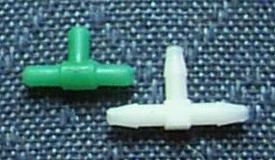 If you have the Top End unit, they should
have provided a "T-shaped" splicer (see right): put this on the end
of the hose from the bypass valve so the bottom of the
"T" is firmly in the hose; next you need to figure out
where to splice it--I would recommend putting it about 1/3 the
distance between the manifold and boost sensor, but it will work
fine spliced anywhere on this line! Cut the boost gauge sensor
hose and put the "T" piece in between the two cut ends
and connect them firmly to the "T." With this done you
will have a tube coming off the manifold that will then split and
run both to the boost gauge AND to the bypass valve!
If you have the Top End unit, they should
have provided a "T-shaped" splicer (see right): put this on the end
of the hose from the bypass valve so the bottom of the
"T" is firmly in the hose; next you need to figure out
where to splice it--I would recommend putting it about 1/3 the
distance between the manifold and boost sensor, but it will work
fine spliced anywhere on this line! Cut the boost gauge sensor
hose and put the "T" piece in between the two cut ends
and connect them firmly to the "T." With this done you
will have a tube coming off the manifold that will then split and
run both to the boost gauge AND to the bypass valve!
The Bypass Valve is a passive device. There
is an adjustment screw on it which changes the triggering
sensitivity. You can adjust it to only open under large boost
changes, or you could adjust it so it opens almost everytime you
shift. The bypass valve "senses" when you shift or chop
the throttle by the DECREASE in manifold pressure. If this change
is big enough to trigger the unit, a spring-loaded valve will
immediately open and the excess boost pressure will fire out the
bottom of the bypass valve. You will be rewarded with an audible
"whooosh!!" as your boost is released.
Since the excess boost is dumped it can not
backfire on the turbo's turbine and stall it and cause wear on
the bearings!! This will keep the turbo spinning happily between
shifts so that when you come back on throttle your boost will
rise back up VERY quickly. After you get over the sound of the
valve in action you will see the boost needle on the gauge
jumping right back up after shifts!!
Now for how to adjust the valve
First remember that this valve will NOT harm
your engine no matter how it is adjusted; so you have plenty of
experimental time to get the valve adjusted the way you want.
Simply undo the bottom set screw and then turn the end of the
adjustment screw. Replace the bottom screw when done adjusting
and give the car a test drive.
I'm not sure how your bypass valve will be
factory-set but it will probably be somewhere in the middle of
the adjustment range. If memory serves me right, turning the
adjustment screw counter-clockwise makes the valve "more
sensitive"--meaning it will open under smaller drops in the
manifold pressure. Along this line, a "very sensitive"
setting will cause the valve to open almost every time you shift.
If you turn the screw clockwise, the bypass valve will become
"less sensitive"--meaning there will have to be a
larger drop in boost for the valve to trigger. Thus, if the screw
is adjusted far clockwise, the valve will ONLY open under full
boost drop.
The spring in the bypass valve usually
changes its properties a bit as it gets "worn in." Thus
you may notice the need to re-adjust the sensitivity after using
the valve for some time. This should only happen once or twice.
Have fun with your new valve and let me know
how you like it. You will be happy to have the added response of
the boost between shifts, and you will hear the large amount of
energy stored in the boost when it dumps---just think, this used
to be backfiring thru your turbo trying to tear it apart!!
Scott
Aguilar has a fix for a Bypass Valve with too stiff of a spring:
 Last night, I did the switchover from the
stock RED spring to the new BLUE spring. (Also, on the tension screw of
the bypass valve, I noticed the head had a Red Dot on it. I think that's
how HKS makes sure what spring is in the bypass valve) Top End said
all I needed to do was open up the bypass valve and swap the springs.
After removing the 3 hex screws from the face of the bypass valve, the first
thing that I found was HKS used some sort of glue to hold the 2 halves together.
I had to use a very sharp edge to pry the halves apart. Then I noticed
that the bladder in the unit was glued to the front half. After some
careful prying, I got 1/2 of the bladder off (no reason to take the whole thing
off since all you need to do it get the spring out and put the new one in).
Last night, I did the switchover from the
stock RED spring to the new BLUE spring. (Also, on the tension screw of
the bypass valve, I noticed the head had a Red Dot on it. I think that's
how HKS makes sure what spring is in the bypass valve) Top End said
all I needed to do was open up the bypass valve and swap the springs.
After removing the 3 hex screws from the face of the bypass valve, the first
thing that I found was HKS used some sort of glue to hold the 2 halves together.
I had to use a very sharp edge to pry the halves apart. Then I noticed
that the bladder in the unit was glued to the front half. After some
careful prying, I got 1/2 of the bladder off (no reason to take the whole thing
off since all you need to do it get the spring out and put the new one in).
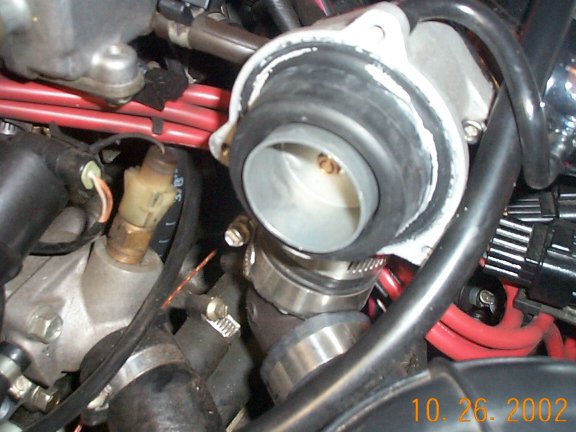 I pulled the red spring and placed the blue spring in its place. I
contemplated using gasket compound before closing it up. I gave up on that
idea since the 2 halves had a groove that held the bladder in place. Since
the pressures are not great, I felt there was no harm. Plus, it was better
to try it without any compound, then if it did not work, I could always put some
on afterwards. Closing up the unit was as easy as replacing the 3 hex
screws.
I pulled the red spring and placed the blue spring in its place. I
contemplated using gasket compound before closing it up. I gave up on that
idea since the 2 halves had a groove that held the bladder in place. Since
the pressures are not great, I felt there was no harm. Plus, it was better
to try it without any compound, then if it did not work, I could always put some
on afterwards. Closing up the unit was as easy as replacing the 3 hex
screws.
The blue spring is rated for 7-14 psi. So, I wondered if I should crank
the tension screw down or leave it loose. I opted to start tight and screw
it down. Time for the test drive.
The first thing I noticed was a greatly improved audible report from the bypass
valve. No more intense snorting (but some still remained). I then
stopped and set the tension screw to all the way open, then one full turn
closed. In theory, this should be around the 7-8 psi range. This
"should" cause me trouble since I know I am putting at least 12-13 psi
through the intake. 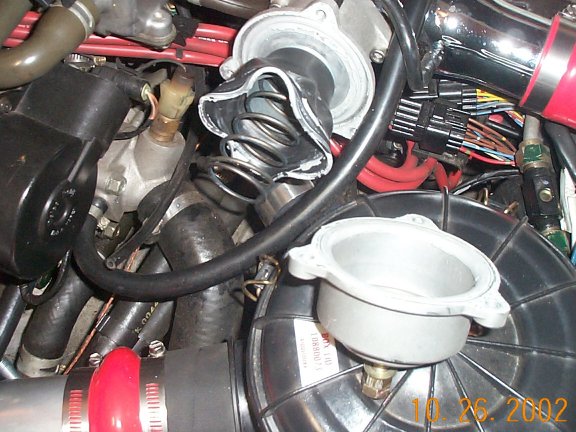 Well, I was very, very pleasantly surprised. The
snort was completely gone except under 0.9bar+ conditions, and even then, it was
75% rushed air noise and then ended with a diminished snort. Nothing like
the constant snort that was present under the other spring. (Also, I think
the loose setting is working due to the metallurgical characteristics of
springs. It's stiff now. As time goes on, I feel I will need to
increase tension. The Red spring did not leave such room.)
Well, I was very, very pleasantly surprised. The
snort was completely gone except under 0.9bar+ conditions, and even then, it was
75% rushed air noise and then ended with a diminished snort. Nothing like
the constant snort that was present under the other spring. (Also, I think
the loose setting is working due to the metallurgical characteristics of
springs. It's stiff now. As time goes on, I feel I will need to
increase tension. The Red spring did not leave such room.)
I know I am not leaking through the bypass valve as the turbo pressure
characteristics have not changed. Actually, the acceleration is better.
I think it's because the turbo is now free spinning when before the snort was
slowing it down.
So, for $10-17, I strongly recommend getting the BLUE spring. The total
time to replace it was under 30 minutes. The results will bring a smile to
your face.
Happy Elaning, Doug