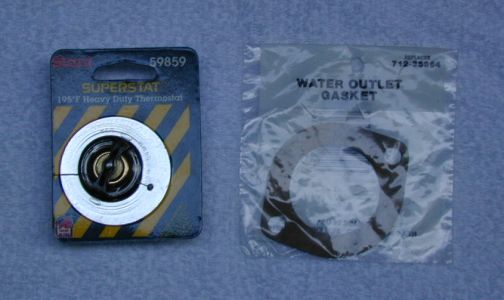
The Thermostat sits on the end of the engine and regulates the coolant flow from the engine to the radiator. It its normal state it is CLOSED and it keeps the coolant within the engine. This allows the engine to get up to running temp and helps with emissions and mileage. Once the coolant within the engine rises to running temp/thermostat temp, the thermostat will open and allow the hot coolant out of the engine and start the circulation loop to and from the front radiator.
During hot and cool driving the thermostat will open and close as you drive to regulate the engine coolant temperature. Thermostats are made to open at "SET temperatures." The O.E. thermostat of the 4XE1-T engine is 180F/82C !!
Thermostats usually last about 60-70,000 miles. They usually fail in the closed position which traps the coolant within the engine with no way to circulate to the radiator. This leads to overheating and can result in problems such as blown gaskets or worse! If the thermostat fails in an open position (very rare), it will cause the coolant loop to be permanently open which will cause the engine to take forever to warm up and run at a very low operating temperatures.
How will you know when the thermostat goes out ??
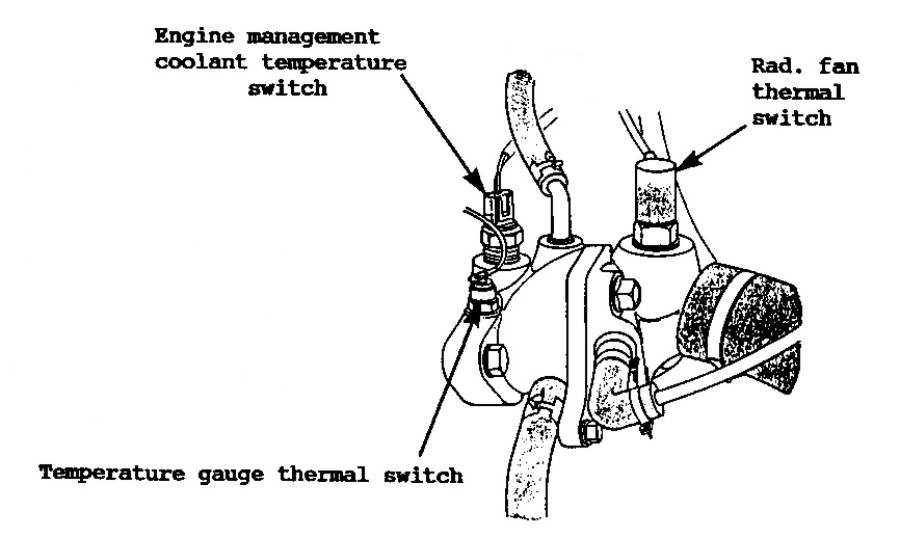
The car will warm up as normal, but the temperature gauge needle will continue to rise. It will become hotter and hotter until something is done about it. Since nothing is wrong except the thermostat, you will NOT see the engine light come on, nor will you notice the engine running abnormally!! I was lucky enough to see the needle rising (my pilot skills paid off with my regular gauge scans!) when mine went south! The radiator cooling fans did NOT turn on at the appropriate time (3/4 of the gauge) and the needle continued to rise. I realized later the reason the cooling fans did not turn on is that the radiator temp probe "thermal switch" is located on the far side of the thermostat housing (see diagram below) and since the hot coolant was not circulating it was not there to make the probe hot!!
The best thing to do when this situation happens is to stop the car before the high temperature causes a serious problem!! I do not recommend continuing driving with the thermostat out. You should find a good parking spot and turn the engine off and let it cool! Do not open the radiator cap or you will be rewarded with scalding hot water in your face!
I was close enough to home AND I realized what was happening so I risked it and continued home with my eye glued to the needle! In this situation there are only a few things you can do to continue driving:
(1) Minimize engine RPMs as you want to keep the heat
production down to as little as possible. Do not try to drive fast
thinking the air flow over the engine will cool it!!--this will just cause the
heat output of the engine to go up and the temperature will continue to rise.
(2) Turn on the heat full blast and point the vents away from
you. You will notice the heat coming out of the vents is extremely
HOT. The engine is linked to the heater core (a small radiator!) from
within the engine circulation, so using the heater will actually draw heat off
the engine coolant at a small rate! This may be enough to keep the temp
needle from rising more or bring it down a needle width.
If these tricks do not stop the advance of the temperature needle then you MUST stop (or you will be stopping soon anyway!).
| CONDITION | POSSIBLE CAUSE | CORRECTION |
| Overheating | Coolant Leak | Fill/pressure test system |
| A/C Condenser fins clogged | Remove/clean condenser | |
| Radiator fins clogged | Remove/clean radiator | |
| Thermostat stuck closed | Replace thermostat | |
| Clogged cooling system passages | Clean/flush cooling system | |
| Water pump malfunction | Replace water pump | |
| Fan clutch malfunction | Replace fan clutch | |
| Retarded ignition timing | Reset ignition timing | |
| Cooling fan malfunction | Test cooling fan/circuit | |
| Cooling fan motor malfunction | Test fan motor | |
| Cooling fan relay malfunction | Test fan relay | |
| Faulty radiator cap | Replace radiator cap | |
| Broken/slipping fan belt | Replace fan belt | |
| Restricted exhaust | Repair exhaust system |
To replace the Thermostat you will need to acquire a new Thermostat and a thermostat gasket. You can contact your local Isuzu (or Lotus) dealer and see if they have the parts in stock--they may not. Luckily thermostats are a common enough part to be readily available in automotive parts stores! And they are cheap too! Call or go to your favorite auto store and see if they have the parts you need. They will likely have thermostats of varying set temperatures, all of which would fit the car! The common temperatures are 180F/82C, 185F/85C, and 195F/90C . Any of these will work properly in the Elan, but if you cannot find the 180F/82C then get the 185F/85C as it is very similar.
If you cannot find a thermostat you like, you can put the car in a "temporary mode" by simply removing the thermostat and re-assembling the engine without one! This will allow you to drive the car home or to somewhere that has the proper part.
Cost = about $10
Essential Parts:
Possible Additional things:
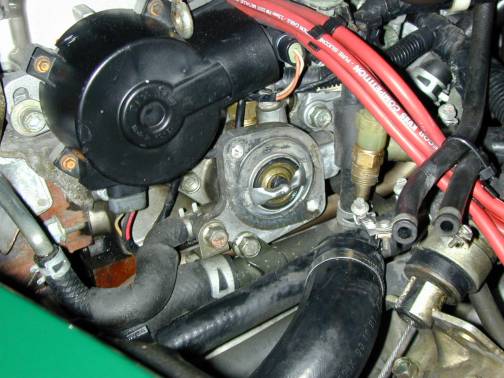
Now is the perfect time to replace your engine coolant as well !!
***To check your
new and old thermostats for proper functioning you can do this simple procedure: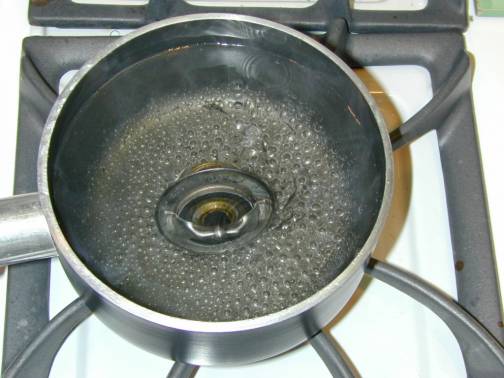 ***
Place the thermostat(s) in a sauce pan full of water on the stove. Heat the water until near boiling. When the water temp reaches the opening temperature of the Thermostat (80 to 90 degrees, depending on its specifications), the thermostat should open fully in the center!! This will help verify the new Thermostat works properly and the old one does not. The picture here is of my old thermostat in 100 degree boiling water and it is fully closed !!
Send any more helpful hints to me and I will add them here. --Doug