
Bypass Valve
Be sure to see pictures at bottom!
Theory: The theory behind the Bypass Valve/Blow off valve can be found on numerous websites regarding turbos and turbo cars. The Bypass Valve is installed onto the pipe which runs between the turbo and the intake manifold. It is a simple open/closed-type valve which sits closed in its resting state. When your foot comes off the gas pedal, as in shifting or decelerating, the throttle plate closes partly or completely. This causes the pressure in the intake manifold to drop. A small tube connects the Bypass Valve to the intake manifold (spliced into the boost gauge sensor line). The drop in manifold pressure sets off a spring-loaded mechanism to open the valve. When the valve opens it gives an audible sound as the turbo "charge" is vented out to the atmosphere. As the pressure equilibrates the valve is shut completely again.
Without the bypass valve installed, each time you shift, the throttle plate closes and the compressed air slams into it and backs up. Having nowhere else to go, the pressure wave recoils back through the intake. This sends a pressure spike back through the turbo's turbine, stalling it and creating undue wear and tear on the turbo bearings! This can be heard in the stock Elan as a stuttering sound each time you shift. This sound is your boost pressure stalling your turbo and coming back out the air filter and duct pipe!
In general a valve installed with its exhaust to the atmosphere is referred to as a "Blow off Valve", while one whose exhaust is directed back into the intake stream is properly called a "Bypass Valve."
 Type: I have had a Standard HKS Turbo Bypass Valve installed by Top End
Performance since May 1998. There are
many companies that offer a Turbo Bypass Valve for sale—also
commonly known as a "Blow-off Valve".
Cost: $375 from Top End Performance—this includes the mounting pipe as detailed below. The pipe comes black but can be powder-coated the color of your choice for an extra charge. Check online for prices from HKS directly and other companies too.
Installation (Install Help): The Top End package includes the HKS Valve mounted to a custom-made metal pipe. This metal pipe replaces the lousy stock rubber hose that fits into the intake manifold and throttle plate. It is simple to install with merely a screwdriver. You must remove the old rubber pipe (look at it, laugh aloud, and throw it aside), and then affix the new pipe with a screw clamp on each end. The Bypass Valve actuator tube is then spliced into the boost gauge sensor tube. It’s that easy!! Should you choose to purchase a Bypass Valve somewhere else, you will need to find a way to mount it securely in place as it cannot be mounted to the stock rubber pipe!
Use: The Bypass Valve is a passive device. There is an adjustment screw on it which changes the triggering sensitivity. You can adjust it to only open under large boost changes, or you could adjust it so it opens almost every time you shift.
Review: The Bypass Valve is an excellent upgrade for the Elan or any turbo vehicle! There is actually a performance improvement just by installing it. Since your turbo is not stalling between shifts, it continues to spin. Therefore, when you hit the gas again there is only minimal turbo lag. It is amazing to see the boost gauge needle drop from full boost down to zero when shifting, followed by it rebounding right back up to full boost as soon as you hit the gas!! This translates into better acceleration through the gears. You get better performance without changing anything on the turbo or engine—you are truly getting something for nothing (other than the cost).
The Bypass Valve does make an audible sound as it dumps the boost (a "silencer" can be fashioned for those annoyed by the sound). I found it truly impressive to actually hear all the energy stored in the boost as it is released! To think that all that energy was surging through the turbo backwards before I had the valve makes me very happy to have it now. I feel installing a Bypass Valve is IMPERATIVE if you raise the boost on your Elan. Without one you will be investing in a new or rebuilt turbo much sooner. Hearing the valve work has changed the way I drive as well. I can come off the gas quickly each time I shift to assure the valve opens and my turbo stays happy or I can ease off the throttle so the excess boost gets "eaten" by the engine without the bypass valve engaging.
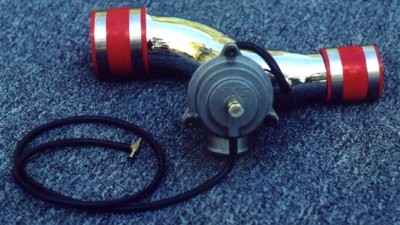
This report just in (1/2001) from Steve P on the Isuzuperformance part:
Just to report back on Bill’s intake pipe (now I've had a
proper chance to try it, its not rained all morning!!: It fitted my Elan better
than the Top End Pipe, it’s slightly shorter which allows for some movement in
the pipe couplings which seems a good thing. I just bought the pipe so I had to
fit the HKS valve which required shortening one of the supplied hex bolts by
about 5mm. The standard of finish is in a different league to the Top End pipe,
being chromed and supplied with red pipe couplings which work particularly well
if you’ve got a red Elan!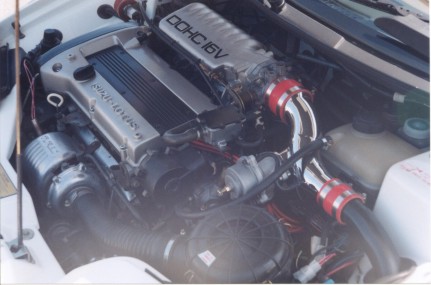 The reason that I decided to give Bill’s pipe a
try after using the Top End pipe was to use the HKS valve as recommend by HKS
for the best results=> Both sides of the valve connected; one positive
pressure from the intake before the throttle flap plus the vacuum intake from
the manifold. (There is a spare 'capped' vacuum intake on the manifold if you
need one, it’s neater than using a ‘T’ adapter, on the UK Elan anyway) The
difference in operation is quite marked. Valve operation is much more consistent
and progressive. Air is released earlier and without such an aggressive
whooossshhh. The valve operation although still audible, does not chatter like
before! I would say that spool-up is quicker, although how much is difficult to
say because I removed the Top End pipe a while ago. Bill’s pipe looks better
and operates the valve in a much more civilised and effective way. I’m just
waiting now for a kit to connect the output of the HKS to the air intake system!
If you’re considering fitting a dump valve I would certainly recommend this
intake.
 Click
HERE
to see a write-up by Philip Brown
in the UK about installation of a Bailey Motorsport Bypass Valve!!
This part set-up only runs about £100
with self-installation.
Check out this ever so sweet set-up of Carbon Fibre intake pipes with bypass rerouting made by Steve Sharpe

Check this link for more info on Steve's pipes and how to buy some from him!!
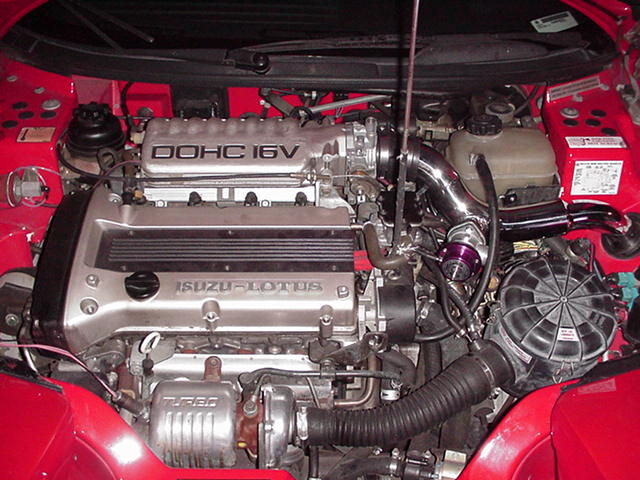
Colin in England has installed a different Bypass Valve onto his native plumbing as pictured below.

Simon Stenner from Coventry, UK, has installed his own Bypass Valve onto his native plumbing as pictured below.
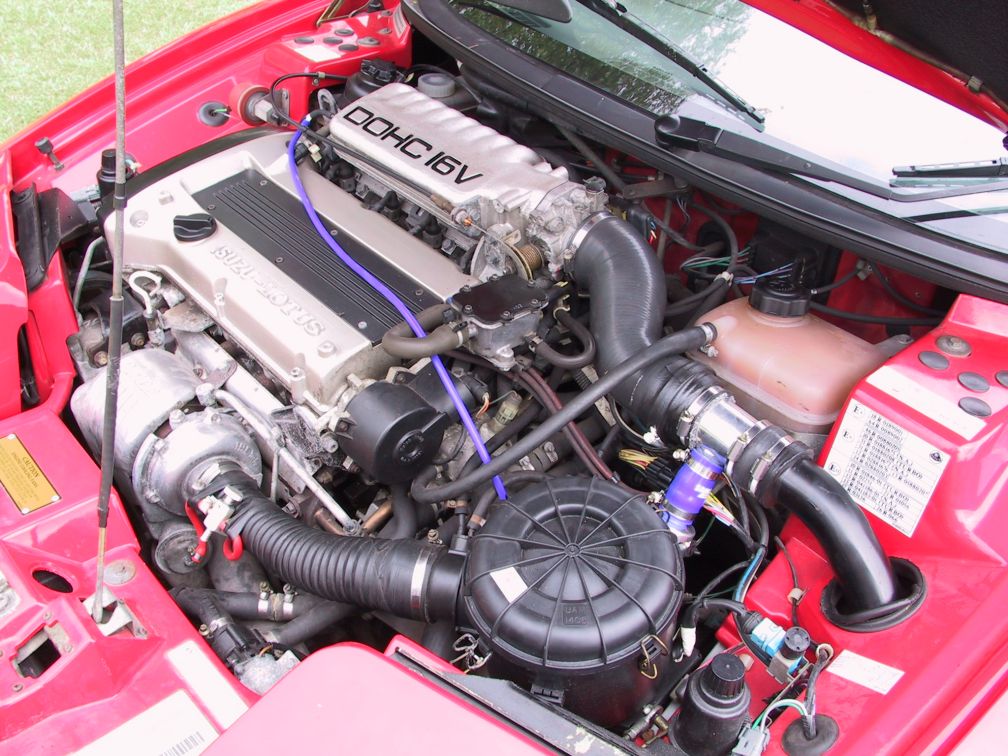
Shawn Gradek has sent some pictures of his custom fab'ed intake on Jamie Y's Elan:
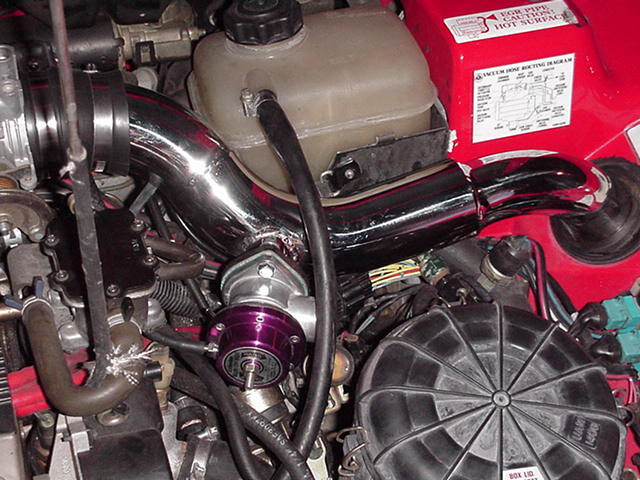
Happy Elan-ing, Doug